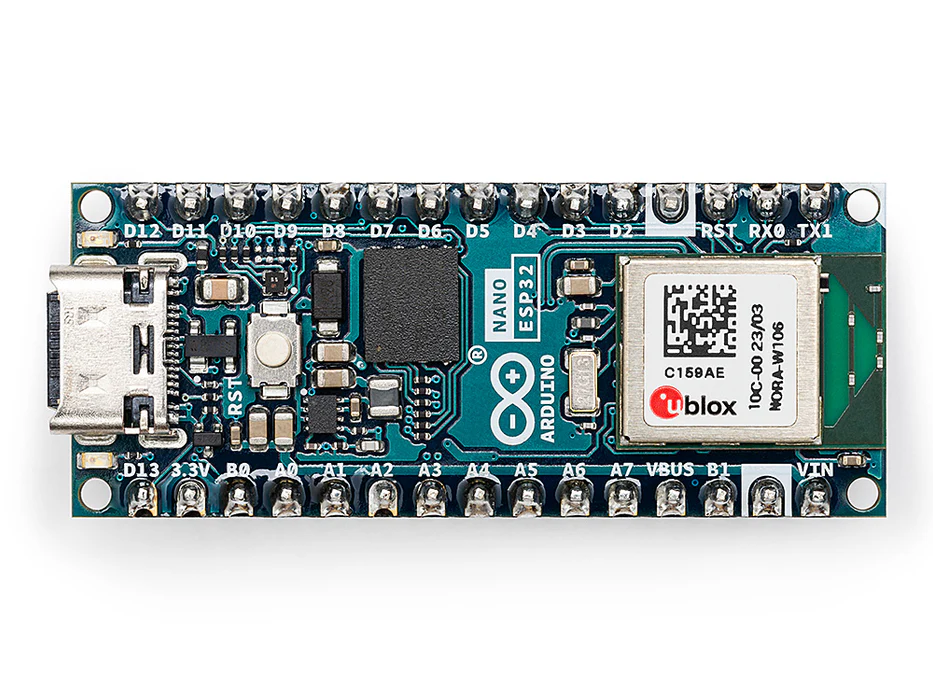
The new member to our iconic Nano family, the Nano ESP32. This board brings all the power of the well-known ESP32-S3 with the full support of the Arduino ecosystem, allowing makers to explore the world of Arduino and MicroPython without any blocker. Just unleash your creativity and start building for the next IoT project.
Overview
Introducing the Nano ESP32, a powerful addition to the Arduino ecosystem that brings the popular ESP32-S3 to the world of Arduino and MicroPython programming. Whether you're a beginner stepping into the world of IoT or MicroPython, or an advanced user looking to incorporate it into your next product, the Nano ESP32 is the perfect choice. It covers all your needs to kick-start your IoT or MicroPython project with ease.
Let's explore the key features of the Nano ESP32:
Tiny footprint: Designed with the well-known Nano form factor in mind, this board's compact size makes it perfect for embedding in standalone projects.
Wi-Fi® and Bluetooth®: Harness the power of the ESP32-S3 microcontroller, well-known in the IoT realm, with full Arduino support for wireless and Bluetooth® connectivity.
Arduino and MicroPython support: Seamlessly switch between Arduino and MicroPython programming with a few simple steps. We even offer an introductory course for those new to the MicroPython world, find more information in the documentation page.
Arduino IoT Cloud compatible: Quickly and easily create IoT projects with just a few lines of code. Our setup takes care of security, allowing you to monitor and control your project from anywhere using the Arduino IoT Cloud app. (Available starting August 2023)
HID support: Emulate human interface devices, such as keyboards or mice, over USB, opening up new possibilities for interacting with your computer.
There are no more excuses to delay your exploration of IoT and MicroPython. The Nano ESP32 provides everything you need to start creating and discovering the endless possibilities.
Arduino IoT Cloud Compatible*
Use your board on Arduino's IoT Cloud, a simple and fast way to ensure secure communication for all of your connected Things.
Learn MicroPython with the best board: the Arduino Nano ESP32. Check the free MicroPython 101 course here!
Get Inspired
FAQs
Is the Nano ESP32 compatible with MicroPython?
Absolutely! This board fully supports MicroPython. For detailed information on setting it up and getting started with MicroPython, please visit docs.arduino.cc/nano-esp32.
How can I power the Nano ESP32?
The Nano ESP32 can be powered in two ways. Firstly, you can power it via the USB port, which activates the VBUS pin as an output. Alternatively, you can supply power through the VIN pin, accepting an input voltage range of 5 to 18 Volts.
Does it use the official ESP32 core?
Yes, if you are an ESP32 user, simply install the latest version of the Arduino Nano ESP32 core through the board manager in the Arduino IDE. For more information, please refer to the official documentation page.
Will the Nano ESP32 be compatible with sketches from generic ESP32 boards?
The Arduino Nano ESP32 can run code written for other ESP32 devices without any fuss. It's designed to be fully compatible with the ESP32 ecosystem, making it easy to port existing code.
I like the fact that delivery is always prompt especially as I am in the UK . i have made a few mistakes getting the right gear together as there are so many variants of Arduino controller. I am pleased with the Nano ESP 32 I have finally landed with which I am purposing on a 50 Watt Solar panel, deep sleep mode, and 100AH LiFe battery. I have been winter testing originally with a NANO R4 Wifi but it takes too much current for the dark months I was testing over Oct/Nov/Dec/Jan I believe I might achieve autonomy but its close run for my Home weather station. Overall I am learning a lot and like the arduino store and what it has to offer.
its nice that it has a RGB and a normal led, and it has 16 MB of external flash, and the microcontroller has 8 MB of internal flash,
i heard that the internal flash was actually SRAM, and it would then have 8 MB ram but it "only" had 512 KB sram, but still to times as much as the MEGA 2560 had flash:)
I bought this board specifically to be able to communicate via WiFi. When I use it via Arduino/C++ with the Arduino IDE, it works perfectly.
But what I want is to use Micropython. Via the Arduino Lab IDE, this works with a lot of manual actions.
Via the Thonny IDE, it works much easier via WiFi... That is a missed opportunity! It would be great if the Lab IDE could also communicate with the Nano ESP32 in a simple way via WiFi, like with the Thonny IDE.
Un prodotto che unisce la semplicità di Arduino alla connettività della famosa ESP32 in un formato compatto, adatto alla realizzazione di piccoli robot... strepitoso!!!
Becoming familiar, over the years, with the Uno and Mega, I was watching out for a project that would usher in my 'day of WiFi' and it's here, fabulous.
This is a really good controller if you want an easy and low cost start with Arduino IOT Cloud. Makes a great remote multi-probe temperature monitor, for example, and your code is easily extended to make a thermostat. Works well with the screw terminal adapter made by Arduino. A brilliant bit of kit with unlimited applications.
I've had a go with this and uploaded a few test sketches and it works great. Not tried the micro-python side of things yet but I will be as this is my programming language of choice.
Good quality.
Sales/delivery process are great.
In my opinion, the price strategy should be reviewed.
I believe that nobody will preffer a “Chinese version” in case of a reasonable price, but the current difference is not helping.
Thanks for very quick delivery - overall it works fine. I have two little ideas to make it even better: Under Ubuntu 22.04 the Micro Python Installer failed and the error message disappeared after a few seconds. It said: Error running dfu-util: 'Command failed: "/usr/lib/micropython-installer/resources/app/node_modules/firmware-flash/bin/linux/x64/dfu-util" -a 0 -d .... - After a few tries I made it to grab the complete error message. After running the command with root privs it worked fine. So if you want to make it better, please keep the error message visibile and perhaps give a hint to run it as root. And I am a little bit surprised about the inaccurancy of the onboard ADC module, I want to use the board to create a battery monitor - even with a very stable input it gives volatile readings - I implemented Tukey-algorithm to make it better. But overall as I said the board it is working fine and I have much fun implementing my little project.
Best Regards
Christian
This addition to the Arduino range is a real winner. have been using MicroPython on a different platform but to use the Arduino as well is very useful.
The Arduino Nano ESP32 has been a reliable component in monitoring temperature, humidity, and TDS levels in my hydroponic setup. Satisfactory performance for precision agriculture applications.
Trying to get a project to function as desired, battling C++ as a newbie, but realising my need to have top-end equipment to have all possibilities to succeed.
Got it working, tweaked a sketch with success - still having miles and miles to go.
Most challenging is the C++ sketch documentation, which lots of times seem to be written for professionals, which means that you are assumed to understand a lot.
Got an angle sensor operating, now I need to pair it with a stepper motor - wish me luck...